3 KNOW-HOWS FOR BECOMING A GOOD MEDICAL SALES REPRESENTATIVE

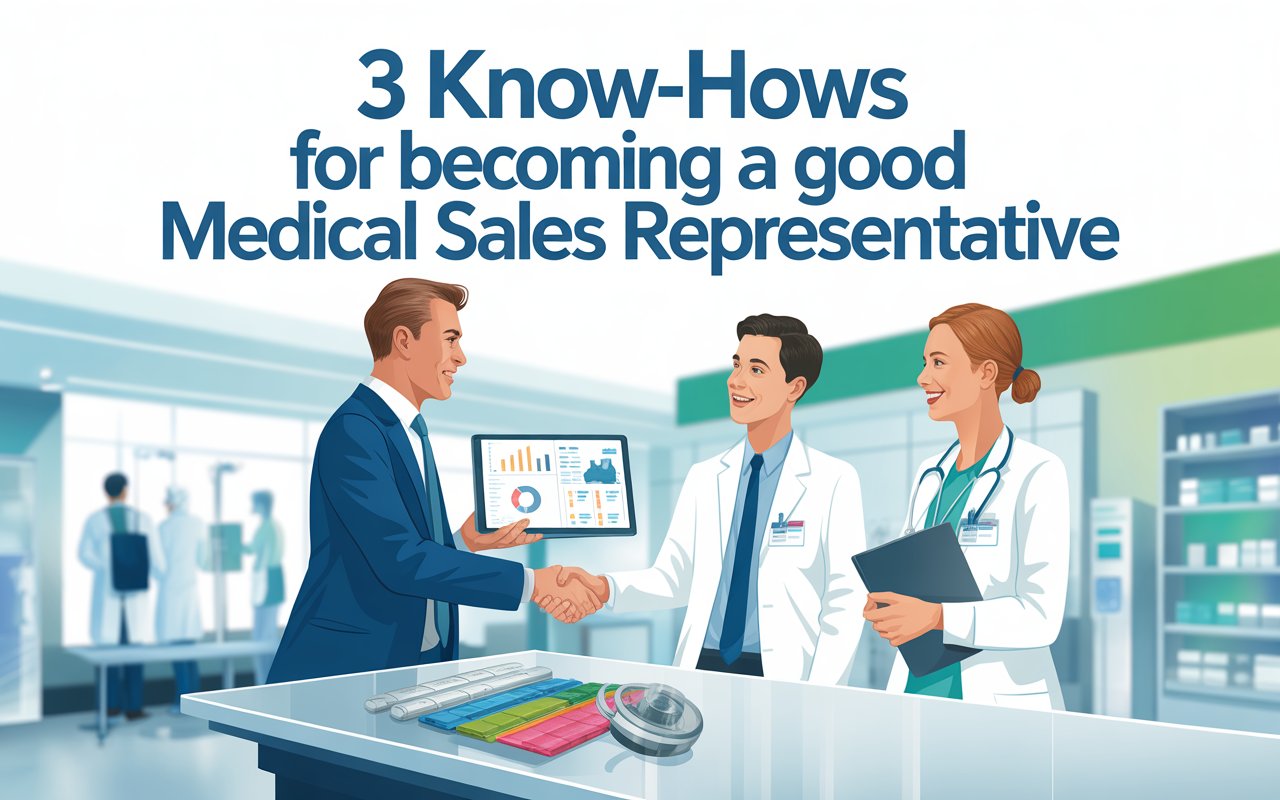
Illustration of a medical sales representative shaking hands with healthcare professionals while presenting a tablet with data charts. The background features a medical setting with shelves of products

You’ll be the vital link between medical and pharmaceutical firms and healthcare providers as a Medical Sales Representative. General practitioners (GPs), hospital doctors, pharmacists, practise managers, nurses, dentists, and veterinary surgeons are just a few of the people you’ll meet. You’ll position and differentiate your items – which might include prescription pharmaceuticals, drugstore or OTC brands, wound care, nutrition, diagnostics, or vaccines – from the competition by using your sales, negotiation, and disease/therapy experience. You’ll learn about the customer’s wants and then market the relevant benefits of your products to get them to commit to changing their prescription behaviours. Medical sales representatives serve as a vital link between pharmaceutical and medical corporations and healthcare providers. One of the numerous motivations to engage in medical sales is the opportunity to assist in the delivery of treatments and medical devices that enhance or save patients’ lives. It goes without saying that a strong work ethic and excellent sales abilities are required to be a successful medical sales representative. However, there’s a lot more to it. To make a name for yourself in the field, you’ll need to gain the respect of your clients and co-workers, as well as demonstrate a willingness to learn and grow. Here are three tips to help you become a successful medical sales rep if you want to make a difference: The key to a successful medical sales representative career is to improve relationships with both new and existing clients. Clients will be hyperaware of whether you keep your commitments, respect them, and make them feel valued in the early phases of a relationship. Positive relationships, according to the Harvard Business Review, are one of the fundamental characteristics needed to develop trust, along with consistency and excellent judgement. Consistency entails being dependable and maintaining current client relationships. Maintain open lines of communication, be dependable, and respond to your client promptly, even if you don’t have an answer. In the medical sales industry, having sales abilities and the capacity to create strong relationships isn’t enough. The ability to understand the product at the same level as your client will offer you an advantage. Because products are created to treat specific medical issues, they can be quite complicated. As a result, you must be aware of the benefits and drawbacks, as well as be prepared to respond to any medical queries that professionals may pose. You should also be well-versed on reimbursement and illness states, as well as be aware of the industry’s significant developments. The number of employees seeking performance feedback has climbed by 89 percent in the last two years. Why? Because feedback is necessary for progress, whether it is positive or negative. Positive client feedback provides insight into the client’s priorities. If they say anything positive about your quick response time and ability to get to the root of the problem, you’ve just disclosed one of your greatest assets. If you’re goal-oriented, like the majority of medical sales people, you’ll enjoy receiving constructive criticism. You’ll have something to work on and improve as a result of this. In more ways than one, technology is revolutionising the sales process. It’s transforming the world around us, in fact. The most valuable resource on the planet is no longer oil, but data. So, how can statistics help you become a more effective medical salesperson? Begin by considering what data you might be able to acquire and how you might be able to obtain insight from it. This may include keeping track of how many clients you speak with each month, your success rate when pursuing new leads versus referrals, or the amount of time you spend on the phone with a customer. Combine your data to form a larger picture of your sales process, allowing you to understand where you’re succeeding and where you need to improve.

How to communicate medical insights effectively?

Introduction Even though, prima facie, the purpose of medical affairs is to develop and maintain external relationships effectively,  medical affairs even refers to building credibility and partnerships with critical healthcare decision-makers. These days organizations are developing a strategic approach for generating compelling medical insights that bring profitable future opportunities. The definition of an “insight” is inconsistent as per the medical affairs function. A medical insight can take many forms, including sentiment, individual perceptions, data points, and trends within healthcare. Medical Science Liaisons (MSLs) fulfill the role of delivering medical insights to any medical or pharmaceutical company. They work throughout a product’s lifecycle, ensuring that the products are utilized effectively, are served as scientific peers and resources within the medical community, and are scientific experts to internal colleagues at companies. However, MSLs gather insights during their interactions with Key Opinion Leaders (KOLs), the leading physicians, and other stakeholders at the company and communicate their findings internally to drive optimum decision-making. An MSL team’s strategic advantage is building essential relationships that grow progressively deeper, improving the quality and potential impact an insight may provide over time. But, many MSLs struggle to understand the difference between an insight and information shared by a KOL. As a result, their communication is ineffective. Hence, the strategic decision-making is not actionable, failing to help with the medical strategy. Thus, breaking the bridge between commercial and clinical stakeholders. Steps for effective communication of Medical Insights To effectively communicate medical insights, the following things should be taken care of : 1. Prioritization Only utilize valuable insights, which tend to be new, forward-looking, actionable, and helpful in making decisions. While gathering information, MSL must ensure to curate only relevant and valuable information, such as: 2. Ask yourself about “PAL- Purpose, Audience, and Logistics.” Purpose – Always consider what you want the reader or listener to know, feel, or do when they receive this information. Key Question- What is your purpose in sharing the insight, and how do you expect the information to be used? Audience – You must know the target audience for these insights. Key Question- Logistics – You must know beforehand what methods will you use to share the information, and is it compatible with the company? Do they want it via insight sharing platform or conference call, or email? Remember, once you have determined all of the three, write down your overall objective. In other words, begin with the end in mind. 3. How to frame the insight? Use the following framework for best results- Circumstance – Keep your introduction short, but be sure to include the people, time, and place of the insight. Action – What happened? Was there a positive or negative experience, a new idea, a theme that you noticed from multiple interactions? Result – What is the result of the experience? What are the next steps? Is a response needed? 4. Create a mechanism for MSLs to elevate the urgent insights When an MSL discovers a critical understanding that the organization should act on immediately, the insight needs to get to the correct internal stakeholder directly; else, there would be a lag if it goes into a reporting cycle. Ensure that the MSL identifies what is urgent and shares it on a high-priority basis. Here are some ways you can choose to share urgent insights: 5. Industry Benchmarking and Competitive Analysis To stand out, position yourself relative to the behavior of your key competitors. Key questions include:

Insights To Pharma Marketing Success For Stronger Brand Value And Sales

Introduction to analytics based marketing New or improved products are not the major driving force of more pharma revenue. As such, successful marketing should be the top priority for all major pharma companies, and they should spend more on marketing than they do on research and development. Branding is the only way to differentiate companies from each other. Pharma companies have a tendency to focus their marketing efforts towards targeted physicians instead of the actual consumer. However, the key to growth is more closely associated with understanding and identifying customer needs, and finding solutions to meet these needs. Most pharma marketing deliverables are more or less the same so how do they stand out? The answer is – Analytics based marketing. Measuring data is now an important element for effective marketing. Marketing analytics metrics should include many factors including sales, costs and profits. Branding is important but data analytics are needed to measure success and analytical decision-making can save both time and money for pharma companies. Two prong marketing: Doctors and Patients Pharma marketers always target two audiences – patients and doctors. Doctors hold the key to consumer sales and establishing a relationship with them is a good way to reach and communicate with a much wider audience. Consumers will consult their local doctor before purchasing a pharma device or prescription of some kind. and are much more likely to buy after recommendation from their doctor. Therefore, marketing to doctors is beneficial and different strategies are needed to address both doctors and patients. Marketing to patients Most patients now use online search engines to find information or solutions and therefore, marketing to patients is about identifying individual needs and creating an experience that is efficient and valuable to meet their needs. Creating this patient experience relies heavily on strong search engine optimization and user experience. Companies that provide clear and efficient solutions to their search queries, will inevitably experience sales and revenue. For example, if a pharma company markets a drug or treatment for depression, they should directly target the end-user through search engine optimization and content marketing. Marketing to doctors Marketing to doctors requires identifying the professionals needs and providing well-researched solutions in a creative way through tactical media placement. This is not cheap since competition and investment is high. The three most important considerations for marketing to doctors are: 7 expertise pointers that led to this success case study

Unleash The Power Of Video Marketing In The Pharma Industry

Relevance of  Video Advertising in the Pharmaceutical Industry A video is worth approximately 1.8 million words. Videos provide a unique and powerful medium to market your products or services since they grab people’s attention. This makes videos necessary in your marketing strategies. Authentic videos are greater in attraction and include behind-the-scenes videos, live videos, vlogs, product walkthroughs, etc and they are preferred more by most customers, unlike videos with artificial effects or graphics. Brand recognition increases by 139% when videos are added to marketing activities. Likewise, a video on a landing page increases the conversion rate by 86%. Pharma companies can not only promote their products and services, but can also provide information about the content of the products, and the effects it has on the human body. Other remedies and methods can also be shared.  Companies can therefore,  improve the brand image they wish to portray. Engaging online, before seeking the physician’s opinion has become a more common habit for patients these days. Approximately 60% of people search for online solutions to their healthcare-related questions. Pharma companies can therefore inform patients directly through their medical videos. When building a video marketing strategy consider these  important tips before launching a successful video marketing campaign.

Mastering the right marketing content type that works for busy health care professionals

Health care professionals (HCPs) that constantly learn new things are most respected in their fields. Receiving crucial journal articles, accessing the latest guidelines and other important details are a must for these health care professionals. However, all this can be very challenging due to the sheer volume of information out there, and so it is best to give these HCPs content in short form over digital platforms. HCPs are most open to only three types of content from pharmaceutical marketers: Patient supportive content and medical practice enhancing information are where maximum frequency touch points can occur as this content helps in patient adherence to prescribed therapy, and grows the HCPs clinical image and success. Even HCPs are now a mobile-first audience, so all content must be personalized as per their topic of interest, how elaborative, when to send it, and the HCPs location all matter to some degree. All the content must have seamless integration across all devises and platforms, be it video films, graphics and text. Regular emails with news relevant to the HCP from the top most medical associations and professional societies should be encouraged. Informative and creativity in delivering the content is important. Animations, or scrolling text could help by being creative and condensing the information. Real-world case studies or data can be shared via GIFs and short video clips. Various social media platforms where HCPs frequent can be used such as LinkedIn, Twitter, and Facebook.

15 writing hacks from a senior accomplished medical writer

How to give, and get the most from the readership of your content Readers reading your content expect to get to exactly what they are looking for, in as short as possible time necessary. Readers are more likely to skip to content relevant to them, and studies show that the chances of every word being actually read is probably only 20%. The readers experience you create with your writing is eventually what matters. This experience is what will engage them and welcome more content from you in the future. Here as some check points to master a better reader experience.

Top 5 social media hacks every top pharma marketer should master

Your presence on social media defines your reach. The more you promote your brand on social media sites, the stronger is your customer-connect. More than 2.95 billion people are using social media worldwide. If you’re not taking your brand to social media, you’re missing those millions of consumers. Successful pharma marketers cannot afford to not focus on publishing their brand information on social media. Even though more than 40% of consumers believe that information found via social media affects the way they deal with their health, unfortunately, a major proportion of pharmaceutical companies are still unable to mark a fair social media presence, and are not able to answer consumer queries. So, maximize your pharma marketing efforts by making social media marketing as your primary strategy with these 5 hacks. Let’s begin this journey! 1. Post content of value for your audience Great content is key! It always works. Be authentic about the information you post on social media and your audience will never be disappointed. Good content creates followers but great content creates value! Try to address the common questions and pain points of the audience. Whether you make them aware of your brand, or you post some generic information, your content should be value-driven. Doing this will help build that real connection between your company or brand and the audience. Bonus tip: Never always post content with a marketing purpose or just about your brand, be more consumer-friendly while creating or posting content. 2. Believe in employee advocacy The audience loves to see the actual brand builders. It has been found that viewers feel more connected with that brand who’s CEOs or Chief Digital Officers are active on social media. Employee advocacy is one of the fastest-growing social business programs. A message coming directly from the real person behind the brand is proven to be more effective. This is because people trust people more than just advertisements. Top companies are very great at this; their CEOs build a transcendent connection with their audience. This can be seen on their twitter profile very frequently. So, showcase your employees with a positive voice for your audience. This  will increase your reach and will give your audience a better experience of your brand. 3. Repurposing content is a great idea Content repurposing is finding new ways to reformat your existing content and it has several benefits. Repurposing content can help you reach a new audience and it puts that old favourite up-front. In the pharma sector, there is a varied scope for content repurposing. You can try infographics or webinars or podcasts over texts. Webinars can be re-formatted to create an informative teaser by just including important highlights. Try YouTube for the same, since your audience spends most of their time on YouTube these days.  Along with YouTube, you can use Facebook for the same type of content formats as it has a larger audience. This is just one example where you can repurpose a long blog post to create infographics or presentations based on it. 4. Video marketing: Best for ROI What you see and hear you remember more, than when you only read! Posting video on your social media pages can increase conversion rates by up to 80%! Videos bring the highest ROI out of all content formats because the viewers retain 95% of the communication presented in a video. Short explainer videos with relevant information quickly captures the attention of the audience; and helps consumers better understand your product. 59% of viewers say that if they have text and video on the same topic, they will choose a video. The best examples of video marketing effectively present their brand for their audience by posting short videos explaining their products with very less text in an easily understandable manner. Do this and you’ll notice a significant transformation in your online engagement. 5. Automated customer service support Responding to the consumer’s queries 24X7 is a must to market your product effectively. Consumers appreciate companies that are ready to serve them anytime. The demand to answer to customer service 24X7 is challenging to manage; but chatbots and messaging apps have made this convenient. In this world of online business, artificial intelligence (AI) is your best friend. These days’, chatbots mimic human behaviour while responding to the customer queries. You can use tools like Google Duplex AI, which acts like a human-helper and is ready to assist customers anytime. You can link a chatbot to Facebook and never miss out on consumer queries for stronger values. Once you start implementing these 5 strategies to your pharmaceutical marketing, you’ll notice a positive change in your brand presence and ROI. Try to curate valuable content and promote it to every social media platform. Find new ways to re-format valuable content and post. Never let your brand get out of the sight of your audience.

Five work habits that initiate top pharma brand building

A product manager sits at the intersection of multiple functions while going about building and implementing the vision for his products success. Here are 5 things every aspiring pharma product manager should know when creating a big pharma brand: 1.      Write everything down Add as much detail as you can, and ensure to include all the customer research gathered to build a rock-solid case. As a product manager, this step alone really even makes you question your stated assumptions. Product design requirements, design notes, callouts, and meeting minutes – and everything, must be written down. 2.      Smaller bite size chunks As you plunge deeper into your project, you will realize that it’s easier for you to design and sketch your ideas when you break them down to the bare minimum. Cutting down empowers you to focus on better quality. 3.      Focus on the details Show you care for your target audience by focusing on every small and fine details. What key elements should you highlight? What colors must you choose? Keep an eye on the big picture, but focus more on the finer details. 4.      Don’t just tell, SHOW using mockups Design unimaginable interactive mockups and workflow to help your users and do ask for early feedback. Having mockups early in the game allows you to prune unwanted interaction and identify potential pitfalls. 5.      Observe, don’t ask Customers that use your product daily, will want you to appear successful because that makes them successful too. Get the customers involved in creating the product so that they feel as if they were designing the product. It is far better to observe how people interact with your product, instead of asking them what they liked or didn’t like. When you ask, what they like or didn’t like, you get different reflex responses which may be out of courtesy. This “hands-on” play with the product helps you identify real issues.

Factors that influence the market cap of pharmaceutical companies

The global Pharmaceutical industry is one of the most dynamic, turbulent and complex economic space in the modern times. A typical Pharmaceutical company invests millions in research & development, therefore sound knowledge of the global trends of the factors affecting the market capitalization are important in strategizing business advancement: 1) Research & Development: According to Pharmaceutical Manufacturers Association, the leading expenditure in this industry is on research & development. After the trials, the company gets one year’s patent protection before the competitors are allowed the rights to manufacture and market equivalent drugs at half the price. 2) The patient-first business model: This model is increasingly being preferred over the traditional approach of sales regulation through health practitioners. With digital media providing health awareness in a click, more emphasis is being given on individual patient collaboration and effective communication. Pharmaceutical data analytics are becoming more relevant to regulate commercial success. 3) Introduction of biosimilars: The rapid Introduction of biosimilars has made the market tenfold times competitive. Drugs for debilitating disorders are made available at much cheaper pricing than the pricing of the patent companies. 4) Precision medicines: Pharmaceutical companies are investing massively on precision medicines, as trial and error procedural costs are eliminated and target-based concise treatment strategy is ensured, tailor-made to the patient’s requirements. 5) The digitalization of the health care sector: Starting from electronic records to genome mapping, digitalization has phenomenally revolutionized the industry. Mobile health sensors and wearable devices, offers end to end monitoring of a patient’s progress. 6) Government Regulations & Marketing: Over the decade, the demand for heavily marketed lifestyle drugs has increased consumer acceptance. There is massive demand for drugs that are claimed to enhance preventive approach and improve the quality of life. Therefore, effective marketing and sales strategy to target lifestyle drugs are on the go. Incorporation and careful consideration of all these factors are imperative for the strategic pricing and market cap monitoring of the pharmaceutical industry.