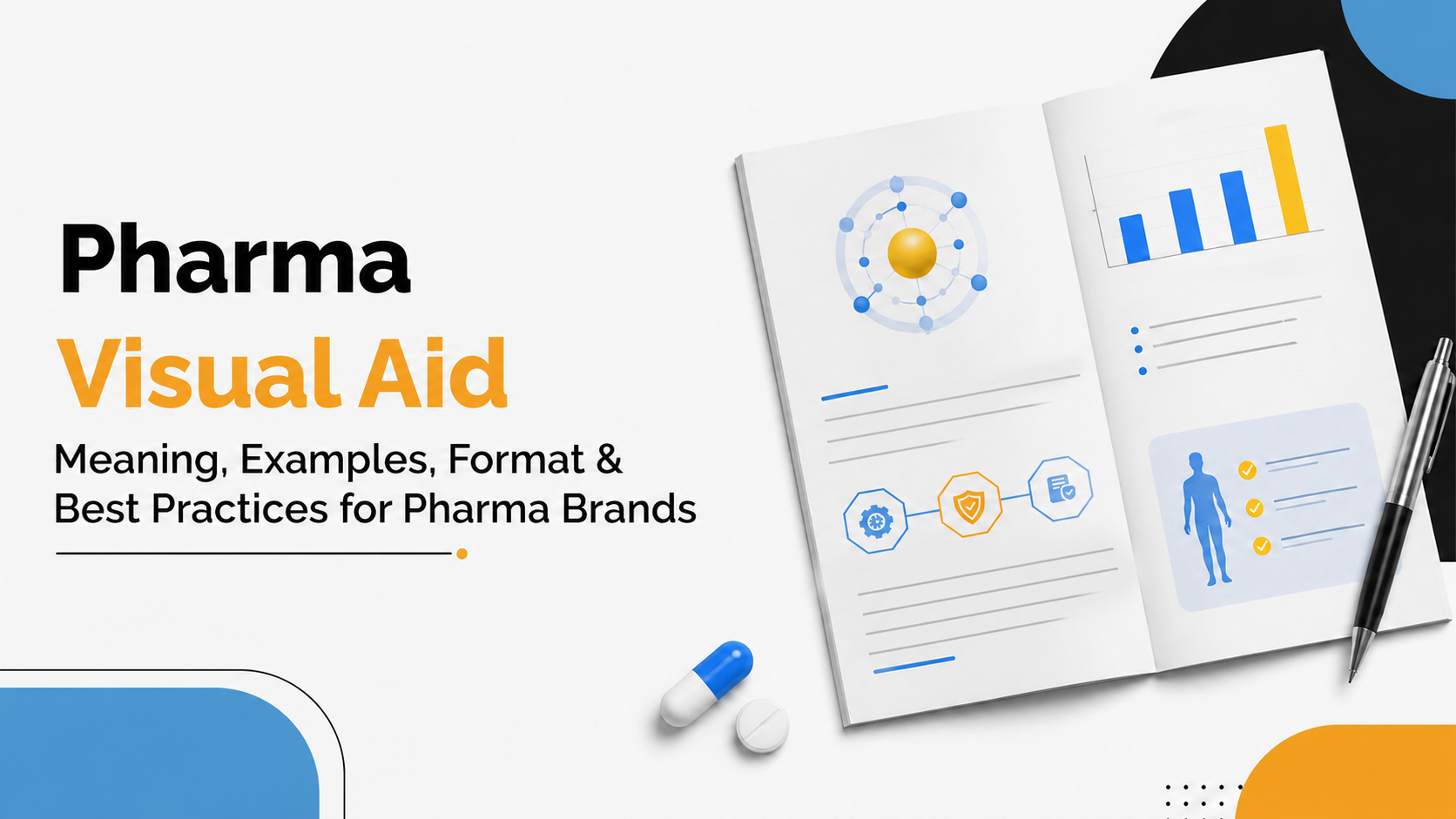
Pharma Visual Aid: Meaning, Examples, Format & Best Practices for Pharma Brands

A pharma visual aid is one of the most important communication tools used by a medical communication agency to simplify scientific information and support pharma brand communication. It helps medical representatives, product managers, brand managers, and medical communication teams explain product information to doctors and healthcare professionals in a clear, scientific, and engaging way. In today’s competitive pharma market, doctors have limited time for product discussions. A well-structured pharma visual aid helps simplify complex medical information, present clinical evidence, highlight product benefits, and create better brand recall. Whether used as a printed booklet, digital presentation, e-visual aid, or tablet-based detailing tool, it plays a key role in doctor engagement and pharma brand communication. This guide explains the meaning of pharma visual aid, its format, examples, key components, design best practices, and compliance checklist for pharma brands. What Is a Pharma Visual Aid? A pharma visual aid is a printed or digital medico-marketing tool used by medical representatives to explain a medicine, therapy, formulation, medical device, nutraceutical, or healthcare product to healthcare professionals. Since a visual aid includes clinical evidence, dosage, safety information, references, and brand messaging, it should be developed with strong scientific content writing services.  It usually includes the brand name, generic name, composition, indication, mechanism of action, dosage, clinical data, product benefits, safety information, references, and prescribing details. These details are presented using medical copy, charts, infographics, illustrations, product visuals, and structured brand messaging. Pharma Visual Aid Meaning in Medical Marketing In pharma marketing, a visual aid works as a communication bridge between the brand and the doctor. Instead of only speaking about a product, the medical representative can use visual pages to explain the product story step by step. For example, a good visual aid can show the disease burden, patient need, product composition, mechanism of action, clinical evidence, dosage schedule, and safety profile in a visually appealing format. This makes the conversation more professional, scientific, and easy to understand. A strong pharma visual aid not only explains the product but also supports strategic brand positioning by turning product science into a clear doctor-facing message.  Who Uses Pharma Visual Aids? Pharma visual aids are commonly used by: For product managers, the visual aid helps convert brand strategy into field communication. For medical representatives, it becomes a guided doctor-detailing tool. For doctors, it helps quickly understand the product’s value, clinical relevance, and patient suitability. Pharma Visual Aid vs Brochure vs LBL Many people confuse pharma visual aids with brochures, LBLs, and reminder cards, but each has a different role. A pharma visual aid is mainly used during doctor detailing. It helps the medical representative explain the product through a structured flow. A brochure is usually a general promotional or educational document used for doctors, patients, or distributors. An LBL, or leave behind literature, is given to the doctor after the visit. It usually summarizes the key product message, benefits, dosage, and references. A product reminder card is a smaller tool used to keep the brand name and key message visible in the doctor’s clinic. A strong pharma campaign may use all of these tools together for better recall and engagement.Pharma brands often combine visual aids, brochures, LBLs, and other medico-marketing collaterals to improve product recall across doctor interactions.  Why Are Visual Aids Important in Pharma Marketing? Visual aids are important because pharma marketing requires clear, accurate, and scientific communication. Doctors are busy, and medical representatives often get only a few minutes to explain a product. A well-designed visual aid helps make that short conversation more focused and impactful.Visual communication is especially useful in healthcare because research shows that visual-based health communication can improve health literacy and the comprehension of health-related information.  They Improve Doctor Detailing A pharma visual aid gives medical representatives a clear flow for doctor interaction. Instead of discussing random product points, the representative can follow a logical sequence: disease need, product introduction, mechanism of action, clinical evidence, benefits, dosage, safety, and closing message. This improves the quality of doctor detailing and helps the representative communicate with confidence. They Simplify Complex Medical Information Pharma products often involve complex details such as mechanism of action, clinical trial data, endpoints, dosage, contraindications, and patient selection. A visual aid simplifies this information through charts, icons, diagrams, and medical illustrations. For example, a mechanism of action can be explained better through a visual pathway than through a long paragraph of text. They Improve Product Recall A strong pharma visual aid improves brand recall by repeating the core product message through visuals, colors, claims, icons, and structured storytelling. When the same message is presented consistently, doctors are more likely to remember the brand. This is especially important in competitive therapy areas where many products have similar compositions. They Maintain Field Force Consistency In pharma marketing, consistency is very important. Every medical representative should communicate the same approved product message. It ensures that the product benefits, clinical evidence, dosage, and safety information are presented in a controlled and approved way. Key Components of a Pharma Visual Aid An effective pharma visual aid should include all important medical, promotional, and compliance elements. The exact structure may change based on the product and therapy area, but most visual aids include the following sections. Brand Name and Generic Name The brand name should be clearly visible on the cover page and repeated naturally throughout the visual aid. The generic name or active pharmaceutical ingredient should also be mentioned where required. Composition or Salt Name This section explains the active ingredient, strength, formulation, and dosage form. For example, a tablet visual aid may mention the salt name and strength, while a dermatology product visual aid may include topical ingredients and formulation details. Indication and Target Patient Profile The indication section explains the approved use of the product. It should also describe the target patient profile in a practical and compliant way. For example, a diabetes product visual aid may focus on patients needing better glycemic control, while a dermatology visual aid may focus on patients … Read more


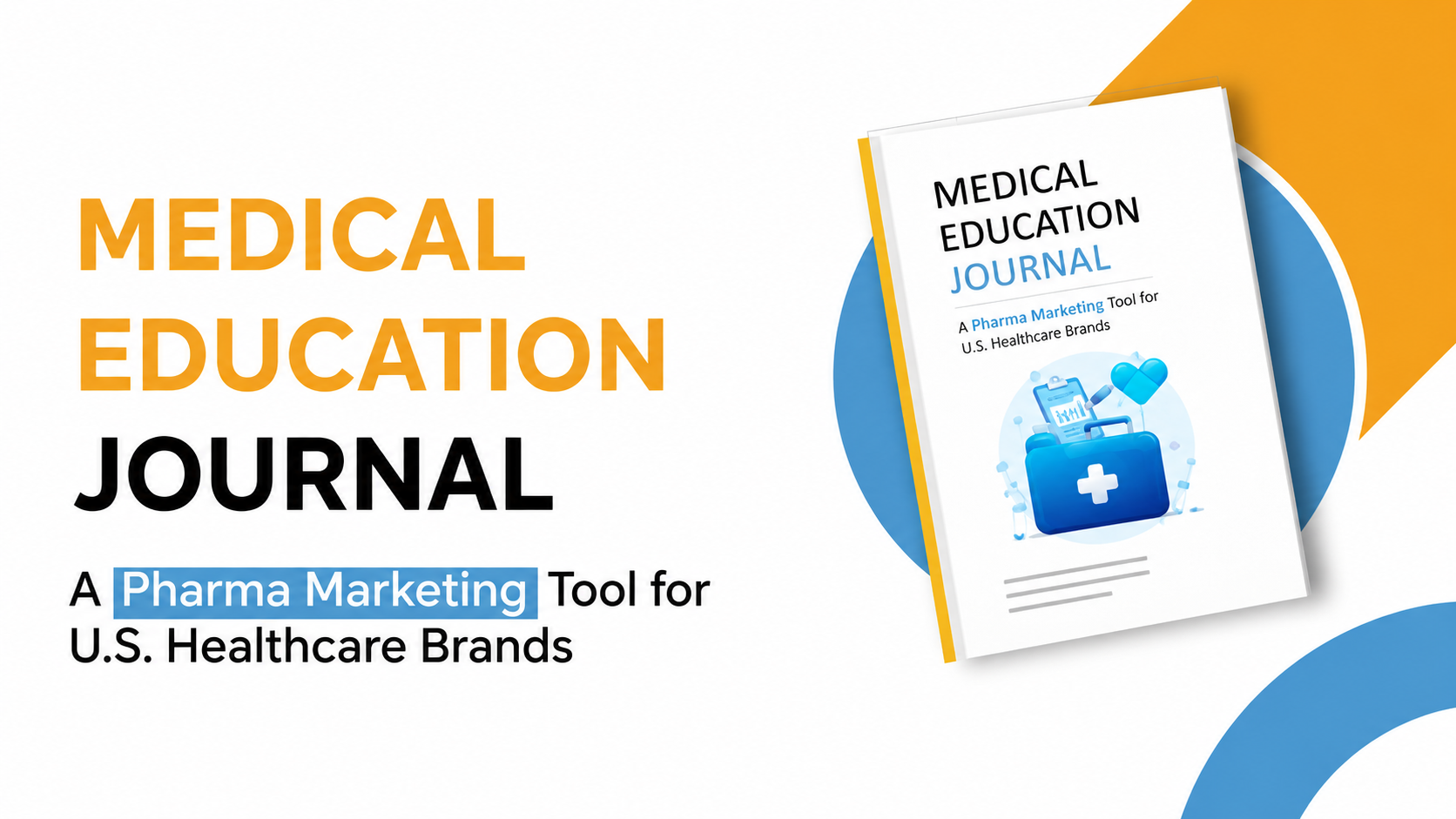
Medical Education Journal: A Pharma Marketing Tool for U.S. Healthcare Brands

Medical Education Journal cover featuring a healthcare marketing guide for U.S. brands, with a blue medical kit illustration and orange-and-blue design.

Every pharma brand operating in the U.S. market wants one thing, the trust of healthcare professionals (HCPs). A medical education journal is one of the most powerful, yet underused, tools to earn that trust. These journals give pharma brands a credible, science-backed channel to communicate with doctors, specialists, and other HCPs in a way that feels educational, not promotional. In a landscape where physicians are skeptical of direct advertising, medical education journals bridge the gap between science and strategy. They deliver real clinical value while keeping your brand in front of the right audience. What Is a Medical Education Journal? A medical education journal is a peer-reviewed or professionally curated publication focused on educating healthcare professionals. Its content covers clinical updates, treatment guidelines, case studies, therapy area insights, and continuing education resources. Unlike commercial pharma ads, these journals are built on evidence. They are designed to improve clinical knowledge and support better patient outcomes. How It Supports Healthcare Professional Education Medical education journals are a primary source of ongoing learning for HCPs. Doctors, nurses, pharmacists, and allied health professionals rely on them to stay current with the latest research, treatment protocols, and clinical developments. Key educational benefits they deliver include: For pharma brands, supporting this kind of education indirectly positions their molecule or therapy area as central to HCP learning. How It Differs from Regular Medical Journals Many people confuse medical education journals with standard research journals. They are related but not identical. Feature Medical Education Journal Regular Medical Journal Primary purpose Educating HCPs Publishing new research Content type CME, reviews, clinical updates Original studies, trials Audience Practicing clinicians Researchers and academics Pharma relevance Higher education and engagement Moderate data publication Access model Often open access Often subscription-based Format Articles, modules, case studies Research papers, editorials The distinction matters a lot for pharma marketing. Regular journals publish data. Medical education journals apply that data to clinical practice, which is where HCP behavior actually changes. Also Read This: These Questions Can Make or Break Your Pharma Brand Plan Why Medical Education Journals Matter in U.S. Pharma Marketing The U.S. pharma market is one of the most competitive and regulated in the world. Traditional marketing channels, rep visits, banner ads, and conference booths are facing growing resistance from HCPs and tighter compliance scrutiny. Pharma brands that rely only on these tools are leaving a significant gap in their HCP engagement strategy. Medical education journals fill that gap with credibility. Why Pharma Brands Need Education-Led Content HCPs in the U.S. make prescribing decisions based on evidence, not promotion. A 2023 report by Veeva Systems found that digital content consumption by HCPs has grown significantly, with educational formats consistently outperforming promotional ones in engagement metrics. Pharma brands need education-led content because: Investing in scientific content marketing for pharma brands through medical education journals is not just a marketing tactic, it is a long-term brand equity strategy. Medical Education Journals vs Traditional Pharma Marketing Tools Here is how medical education journals compare against traditional U.S. pharma marketing tools: Marketing Tool Trust Level HCP Engagement Cost Compliance Risk Medical education journal Very High Deep, sustained Medium Low Rep detailing Medium Short-term Very High Medium Digital display ads Low Low Low-Medium Low Conference sponsorship Medium-High Event-based High Medium Email campaigns Low-Medium Low Low Low-Medium CME-accredited programs Very High Deep, sustained Medium-High Very Low Medical education journals consistently outperform traditional tools when it comes to building the kind of HCP trust that drives long-term prescribing loyalty. Also Read This: Practical Habits Followed by Leaders in Strategic Healthcare Marketing How Effective Are Medical Education Journals for Pharma Marketing? The short answer: very effective, when used with a clear strategy. The challenge is that many pharma brands do not measure results from educational channels the same way they track sales rep performance or ad clicks. Building HCP Trust, Awareness, and Engagement Medical education journals work on three levels simultaneously for HCP engagement: 1. Awareness – HCPs become familiar with a therapy area, molecule, or clinical approach through regular exposure to educational content. 2. Understanding – Deep-dive articles, case studies, and expert reviews give clinicians the clinical confidence to consider a new treatment option. 3. Trust – Repeated, evidence-based communication in a credible format establishes the brand as a reliable source of medical knowledge. This is fundamentally different from how a sales rep or a banner ad works. Educational content builds a relationship with the HCP’s clinical thinking, not just their inbox. According to Doceree’s HCP Engagement Report, HCPs who engage with educational content are significantly more likely to consider a new therapeutic option compared to those who only receive promotional materials. Measuring Results Through Reach, Downloads, Leads, and HCP Actions The effectiveness of medical education journals can absolutely be measured. Pharma marketing teams should track: Pharma medical writing services that specialize in journal content can help build measurable content systems rather than one-off publications. Types of Medical Education Journals Pharma Companies Can Use Not all medical education journals are the same. Understanding the available formats helps pharma brands choose the right vehicle for their goals. Open Access Medical Education Journals Open access medical education journals make content freely available to any reader,  without a subscription. This dramatically increases reach, especially for HCPs in community practice settings who may not have institutional journal access. Benefits for pharma: Examples of well-known open access platforms include PubMed Central, DOAJ (Directory of Open Access Journals), and specialty-specific platforms in therapeutic areas. Medical Education Online Journal Platforms The shift to digital has created a new category: medical education online journal platforms. These are web-based publications and learning portals that combine journal-style content with interactive features. These platforms offer: For U.S. pharma marketing, digital-first journal platforms offer the best combination of content depth and measurable engagement. Continuing Medical Education Journals Continuing medical education journals are a specific and highly valuable sub-category. These journals offer accredited CME content that HCPs need to maintain their professional licenses. Why CME-accredited journals matter for pharma: A strong CME content … Read more

Proven Healthcare Marketing Strategies You Can Learn in 2026

Illustrated healthcare marketer holding a megaphone beside a screen highlighting proven healthcare marketing strategies you can learn.

Introduction What Makes Healthcare Marketing Unique? Healthcare marketing isn’t like consumer marketing. It demands trust, credibility, and accuracy, every message must respect medical ethics and regulations. Unlike lifestyle products, healthcare decisions are deeply personal and often life impacting. So, successful healthcare marketers focus on education first, promotion second. Healthcare marketing strategy isn’t just about visibility, it’s about meaningful engagement, brand credibility, and long term relationships with audiences (doctors, patients, and institutions alike). The Role of Digital Marketing in Healthcare With patients and providers increasingly online, digital channels are central to modern healthcare marketing strategies. According to HubSpot, most consumers research health symptoms and providers online before making decisions. A strong digital marketing strategy for healthcare blends content, SEO, social media, email, and analytics, creating a presence that’s not just visible, but trusted and followed. Also, read this if you want to know more about the evolution of digital marketing in the healthcare industry: The Ultimate Guide to Digital Marketing in the Healthcare Industry Key Components of a Successful Healthcare Marketing Strategy Audience Segmentation and Targeting Understanding who you’re talking to is crucial. In healthcare, audiences are diverse, patients differ from doctors, and even within these groups there are sub segments. Examples:• Doctors segmented by specialty (e.g., cardiologists vs. general practitioners)• Patients segmented by condition, age, and behavior Data backed segmentation helps tailor messages, increasing relevance and response. Pro Tip: Use customer personas, detailed profiles that represent your ideal audience segments. Engaging Content and Storytelling Content isn’t just information, it’s the bridge between your brand and the audience’s needs. In healthcare, content must be:• Accurate and compliant• Clear and accessible• Engaging and helpful A strong content marketing strategy for healthcare educates audiences and answers their key questions, building authority and trust. Here’s a helpful resource on crafting healthcare content:🔗 Content Marketing Institute — Healthcare Content Marketing Guide → https://contentmarketinginstitute.com/healthcare/ Utilizing Social Media for Engagement Social media transforms passive audiences into engaged communities. Platforms like LinkedIn, Instagram, and YouTube allow healthcare brands to:• Share educational content• Highlight patient stories• Host live Q&A sessions• Amplify thought leadership But strategy matters, random posting doesn’t work. Successful teams use data to post what resonates most with their audiences. Unlock Pharma Growth with Expert Digital Marketing Strategies Specially Designed For Medical & Pharma Brands Click To Access The Services Proven Healthcare Marketing Strategies from Successful Teams To truly understand what works, let’s look at real world examples. Case Study 1: Successful B2B Marketing Strategies in Healthcare B2B healthcare marketing strategies often involve long decision cycles and multiple stakeholders (hospital committees, procurement teams, clinicians). Successful teams focus on:• Educational webinars tailored to clinical pain points• Whitepapers and evidence summaries backed by research• Account based marketing (ABM) for high value targets For example, a pharmaceutical brand targeting cardiologists created a webinar series addressing real clinical challenges, resulting in 40% higher engagement than standard email campaigns. Learn more about B2B tactics here:🔗 Forbes – B2B Healthcare Marketing Trends → https://www.forbes.com/b2b-healthcare-marketing-trends Case Study 2: Digital Strategy Success Stories In digital marketing, content + SEO + social amplification win. Example:• A healthcare clinic optimized its website for local search (e.g., “cardiology clinic in Delhi”)• Launched a blog answering common health concerns• Promoted posts through targeted social ads Results:• 50% increase in organic traffic year over year• Higher appointment bookings This illustrates how integrated digital healthcare marketing strategy, combining SEO, content, and social, drives measurable growth. For SEO basics:🔗 Moz – Beginner’s Guide to SEO → https://moz.com/beginners-guide-to-seo How to Create a Digital Marketing Strategy for Healthcare Organizations Step-by-Step Guide for Developing Your Strategy 1. Define Clear Goals What do you want? Awareness, leads, or appointments? 2. Understand Your Audience Segment by role, needs, and behavior. 3. Audit Digital Presence Assess your website, social channels, and content. 4. Keyword & Competitor Research Identify high-value search terms like: ·        healthcare marketing strategy ·        digital marketing strategy for healthcare ·        marketing strategies in healthcare industry 5. Content Planning Create a calendar with: ·        blogs ·        infographics ·        videos ·        webinars 6. Channel Strategy Choose platforms based on audience habits, LinkedIn for doctors, Instagram for patients, email for nurture sequences. 7. Measurement & Optimization Use analytics to track performance and refine tactics. Also, read this if you want to build a solid pharma brand plan: Key Questions to ask before making a pharma brand plan For deeper guidance on digital planning:🔗 HubSpot – Digital Marketing Plan Template → https://www.hubspot.com/digital-marketing-plan Common Mistakes to Avoid in Healthcare Marketing Not Defining Your Target Audience Clearly Without clarity on who you are talking to, messages become generic, and generic messages get ignored. Overlooking the Importance of Data and Analytics Guesswork doesn’t work. Data shows what’s resonating and what’s not, enabling smarter decisions. Instead of relying on assumptions, build a data habit:• Track KPIs• A/B test messages• Refine based on performance Also Read This: Why Pharma Marketing Management Brand Plans Fail in the Indian Market How to Promote Your Healthcare Brand: Key Takeaways from Experts Building Long-Term Relationships with Your Audience Healthcare is a trust-driven industry. Trust isn’t built overnight; consistency, transparency, and value over time create loyalty. Focus on education rather than sales, and your audience will come to you when they are ready. Integrating Offline and Online Strategies for Maximum Impact The best healthcare marketing strategy isn’t siloed. It blends:• Digital campaigns• Events and conferences• Print materials• Email nurturing This integrated approach ensures your brand is seen, remembered, and preferred. How Emediwrite Can Help Healthcare Organizations Enhance Their Marketing Strategies A strong healthcare marketing strategy requires both strategic insight and execution excellence. From audience research to content planning, Emediwrite specializes in:• Data-driven strategy development• Compelling educational content• Multichannel campaign execution If you’re looking to strengthen your marketing strategies in healthcare, across digital and traditional channels, a partner with deep healthcare experience can make implementation faster and more effective. Conclusion: The Future of Healthcare Marketing Healthcare marketing is … Read more

These Questions Can Make or Break Your Pharma Brand Plan

Person holding a chalkboard reading “Ask the Right Questions” beside text about questions that can make or break a pharma brand plan.

Introduction Presenting a Pharma Brand Plan is a defining moment for any marketing team. It reflects not just creativity, but clarity of thinking, market understanding, and execution readiness. In the Indian pharma market, where multiple brands compete within the same molecule and indication, weak assumptions can derail even well-funded launches. Asking the right questions during pharma brand planning helps teams move from activity-based plans to strategy-driven growth. What is a Pharma Brand Plan? A Pharma Brand Plan is a structured blueprint that outlines how a product will be positioned, promoted, and grown over a defined period. A strong brand plan for pharma products integrates market research, competitive analysis, brand positioning, communication strategy, and execution priorities. It ensures that all stakeholders—from marketing to sales—are aligned on one clear direction. Without sharp positioning, even strong pharma marketing strategies lose impact. For a strategic perspective on life sciences branding, you may refer to:https://www.mckinsey.com/industries/life-sciences/our-insights Why is Brand Positioning Crucial in Pharma? Brand positioning in pharma plays a critical role when products have similar efficacy, safety, and pricing. Doctors do not remember brands with multiple messages—they remember brands with one clear idea. Effective positioning defines who the brand is for, what problem it solves, and why it matters. Without sharp positioning, even strong pharma marketing strategies lose impact. Regulatory awareness is equally important while positioning brands:https://cdsco.gov.in/opencms/opencms/en/Home/ Key Questions to Ask Before Presenting a Pharma Brand Plan These focused checks strengthen pharma brand planning, reduce internal objections, and improve confidence during leadership reviews. Common Challenges in Pharma Brand Planning The most frequent challenges in pharma brand planning include weak market insights, copying competitor strategies, and overloading plans with too many activities. Another challenge is misalignment between marketing intent and sales execution. Recognizing these challenges in pharma brand planning early helps avoid last-minute corrections. Industry viewpoints can be explored here:https://www.ipa-india.org/ Steps to Create a Successful Pharma Brand Plan The essential steps to successful pharma brand planning begin with robust market research, followed by audience segmentation, clear positioning, defined objectives, and measurable KPIs. Every brand plan for pharma products should prioritize focus over volume, ensuring resources are used where impact is highest. For comprehensive guidance, explore our insights on developing an effective pharmaceutical marketing strategy. Pharma Product Branding Best Practices Proven pharma product branding best practices include message consistency, doctor-centric communication, simple visuals, and long-term positioning discipline. Brands that focus on education and relevance tend to sustain trust better than those relying only on promotional intensity. Adopting pharma product branding best practices ensures continuity even as campaigns evolve. For global healthcare branding and policy insights:https://www.who.int/teams/health-product-policy-and-standards Conclusion A well-structured Pharma Brand Plan is built on insight, not assumptions. By addressing the right questions to ask before a pharma brand launch, teams can avoid common pitfalls and build brands that are credible, differentiated, and sustainable. How eMediWrite Helps with Pharma Brand Planning and Execution At eMediWrite, we support marketing teams across pharma brand planning, positioning, and execution. We work as a strategic partner offering clarity, structure, and practical support, functioning as a reliable pharma marketing management guide rather than just an execution vendor. As a leading medical communications agency, we provide end-to-end support for pharmaceutical brands looking to establish strong market positioning. Our services extend to digital marketing for pharma brands, ensuring your brand reaches the right audience through the right channels. Frequently Asked Questions What are the key elements of a successful pharma brand plan? Market insights, clear positioning, focused strategy, and measurable goals. How do I determine the right brand positioning for pharma products? By understanding unmet needs, competitive gaps, and real prescribing behavior. What are the common mistakes to avoid in pharma brand planning? Overcrowded plans, weak differentiation, and activity-led thinking. How do I align my pharma brand plan with market needs? Use doctor insights, prescription data, and therapy trends to guide decisions. What challenges do pharmaceutical companies face during brand planning? Differentiation, compliance limitations, and execution alignment. How can eMediWrite help in pharma brand planning? By refining strategy, sharpening positioning, and supporting end-to-end execution.

Why Most Pharma Marketing Management Brand Plans Fail in the Indian Market

Concerned pharma marketing manager beside a declining graph and India map, illustrating why pharmaceutical brand plans fail in the Indian market.

Introduction Many pharma brand plans look impressive in presentations, yet fail to deliver real market results. In the Indian pharma market, this gap is rarely due to lack of effort or budgets. It usually happens when pharma marketing management focuses more on activities than on relevance. Brands end up doing more, but achieving less. Understanding the Indian Pharma Market The Growing Potential and Competitive Landscape The Indian pharma market continues to grow, but it is also one of the most competitive globally. Doctors are exposed to multiple brand messages every day, making attention and recall difficult. These Indian Pharma Market Dynamics demand sharper focus and better prioritization. Many brand plans struggle because they overlook: Without strong pharma marketing management, even good products fail to stand out. Key Pharma Marketing Strategies for Success Tailoring Marketing Approaches for Local Consumer Behavior India is not one single market. What works in one city or region may not work in another. Effective pharma marketing management adapts brand messaging to local realities such as patient affordability, doctor workload, and treatment preferences. Global Pharma Marketing Strategies can guide planning, but execution must always align with how doctors actually practice in the Indian pharma market. Common Reasons Why Pharma Marketing Plans Fail in India Lack of Understanding of Local Market Needs One of the biggest reasons brands fail is weak market insight. When decisions are made without real field inputs, messaging loses relevance. This leads to: These gaps explain Why Pharma Marketing Plans Fail in Indian Pharmaceutical Market and are among the Top Reasons for Pharma Marketing Failures in India. Understanding pharmaceutical product positioning is critical to avoid these pitfalls. Inadequate Pharma Advertising Strategies Overlooking Regulatory Challenges Marketing creativity must work within compliance boundaries. Pharmaceutical Advertising Challenges in India are often underestimated, leading to campaign delays or diluted messages. Common issues include: Such missteps continue to increase Marketing Challenges in Indian Pharma Sector. How to Overcome These Challenges and Build Effective Pharma Marketing Plans Focus on Digital Marketing for Pharma Brands Doctors today engage with brands both offline and online. However, many plans still treat digital as an add-on. Strong pharma marketing management integrates digital touchpoints into the core strategy rather than using them as isolated activities. This integrated approach directly supports How to Improve Pharma Brand Success in Indian Market by improving reach, consistency, and engagement. Our digital marketing services for pharma brands can help you implement these strategies effectively. Collaborating with Local Influencers and Experts Doctors trust peers more than promotions. Associating brands with credible local experts helps improve acceptance and long-term recall, especially in competitive segments of the Indian pharma market. Creating impactful Leave Behind Literature (LBLs) that feature expert insights can significantly enhance doctor engagement. How eMediWrite Helps Pharma Companies Build Successful Marketing Strategies in India At eMediWrite, our pharma marketing management approach is built around insight, simplicity, and execution. We help brands avoid Key Pharma Marketing Mistakes in Indian Market by aligning communication with real Indian Pharma Market Dynamics, while keeping compliance and practicality at the core. Conclusion Most failures in the Indian pharma market are not due to weak products, but weak relevance. Effective pharma marketing management bridges the gap between planning and execution, helping brands succeed despite intense competition and ongoing Pharmaceutical Advertising Challenges in India. FAQ What are the most common marketing challenges in the Indian pharma sector? High competition, regulatory complexity, and poor differentiation remain major Marketing Challenges in Indian Pharma Sector. Why do pharma marketing plans fail in India? They fail when pharma marketing management ignores local insights and doctor behavior. How can pharma brands improve their marketing strategies in India? By aligning brand plans with real Indian Pharma Market Dynamics and focusing on relevance over volume. What are the top reasons for marketing failures in the Indian pharmaceutical market? Lack of insight, weak execution, and compliance gaps are the Top Reasons for Pharma Marketing Failures in India. How can pharma marketing management help overcome market challenges in India? It connects strategy, execution, and compliance into one focused approach. What are some effective pharma marketing strategies for the Indian market? Localized messaging, integrated digital efforts, and insight-driven planning led by strong pharma marketing management.

Doing the Right Pharma Marketing Strategy in 2026: Not Just More Activities

A woman in a professional blazer stands in an office setting, holding a pie chart and pointing to a whiteboard filled with marketing diagrams and sticky notes. The right side features a bold yellow background with the text: "Doing the Right Pharma Marketing Strategy in 2026: Not Just More Activities.

Introduction As we move into 2026, many pharma teams are still caught in the same cycle. More campaigns. More activities. More pressure. Yet the impact on prescriptions and brand recall remains limited. According to Evaluate the total global pharmaceutical market was estimated at around $1.7 trillion by 2030. The reality is simple. Success in 2026 is not about doing more marketing. It is about choosing the right pharma marketing strategy.q Product Managers today are expected to deliver growth in an environment that is crowded, regulated, and highly competitive. Doctors have limited time. Patients are more informed than ever. Market access barriers are increasing. In this situation, the best pharma marketing strategies for 2026 focus on relevance, clarity, and outcomes, not volume. This blog is written for marketing managers who are looking for direction. By the end, you should clearly understand what is the right pharma marketing strategy for 2026 and how to apply it in real-world brand planning. Why Pharma Marketing in 2026 Needs to Evolve Beyond Traditional Tactics Traditional tactics like repetitive visual aids, generic CMEs, and same-for-all messaging are no longer enough. Doctors are exposed to similar content from multiple brands every day. What they remember is what genuinely helps them. In 2026, a strong pharma marketing strategy must: Market dynamics, stricter compliance, and rising competition mean marketing strategies for pharma must evolve from activity-driven to insight-driven. Brands that fail to adapt risk becoming invisible, even with high spends. Understanding how to navigate regulatory challenges is crucial for maintaining compliance while driving impact. Key Pharma Marketing Strategies for 2026 The most effective strategies for pharma marketing in 2026 share a few common principles: Successful teams are aligning their marketing strategy for pharma products with patient outcomes and doctor needs. This is where new pharma marketing strategies like modular content, micro-learning, and hybrid engagement come into play. Our brand strategy and positioning services help pharma teams build this foundation effectively. A future-ready pharma marketing strategy is focused, measurable, and easy to execute on-ground. Check Out this Linkedin post where they talk about the future of pharmaceutical marketing in 2026. Why Personalized Communication Matters More Than Ever in 2026 and How to Implement It Personalization is no longer optional. Doctors expect communication that matches their specialty, practice setting, and patient profile. A one-size-fits-all approach weakens even the strongest pharma marketing strategy. How to implement personalization: This approach strengthens trust and improves recall, making it one of the best pharma marketing strategies for 2026. Learn more about how to communicate medical insights effectively to enhance your personalization efforts. Strategies to Improve Market Access in 2026 A strong pharma market access strategy is critical in 2026. Without access, even the best product struggles. Key focus areas include: Integrating pharma market access strategy early into brand planning ensures smoother adoption and sustainable growth. New Trends in Pharma Marketing Several new pharma marketing strategies are shaping 2026: These healthcare marketing strategies work because they support both doctors and patients. When executed well, they become a natural extension of the treatment process. Content marketing in healthcare has proven to be particularly effective in building trust and engagement. Modern pharma advertising strategies are subtle, ethical, and education-ledmoving away from loud promotion to quiet value creation. How to Develop a Pharma Go-to-Market Strategy in 2026 Many teams ask: How to develop a pharma go-to-market strategy in 2026? The answer lies in alignment. A strong pharma go to market strategy connects product, field force, content, and access planning. Key steps: An effective pharma go to market strategy ensures that marketing efforts translate into prescriptions, not just presentations. Our digital and medical marketing services provide comprehensive support for execution. How Pharma Companies Should Research and Analyze Patient Needs and Preferences Understanding patients is essential for any pharma marketing strategy in 2026. Practical ways to do this: Patient-centric insights strengthen both brand credibility and long-term growth. Global Pharma Marketing Strategy for Emerging Markets A global pharma marketing strategy for emerging markets cannot be copied from developed regions. Local realities matter. Effective international marketing strategies in pharma industry focus on: In 2026, winning brands will adapt their global pharma marketing strategy for emerging markets while maintaining core brand consistency. Understanding international product management challenges is key to successful expansion. How to Measure Success: Metrics for Pharma Marketing Strategies in 2026 In 2026, success is not measured only by reach. A strong pharma marketing strategy uses meaningful metrics: Tracking these indicators helps refine marketing strategies for pharma and improve ROI. Measurement ensures that pharma advertising strategies remain effective and compliant. Conclusion 2026 is not about doing everything. It is about doing what matters. The right pharma marketing strategy for 2026 is focused, personalized, access-driven, and measurable. Brands that adopt this mindset will stand outeven in crowded therapy areas. The future belongs to teams that choose clarity over clutter and strategy over activity. Partner with eMediWrite to transform your pharma marketing approach with expert scientific content writing and strategic consulting. FAQ’s What are the key components of a successful pharma marketing strategy for 2026? A successful pharma marketing strategy includes clear positioning, personalized communication, strong market access planning, and measurable outcomes. How do pharma companies adjust their marketing strategies for emerging markets in 2026? They adapt pricing, education, and engagement models while following proven international marketing strategies in pharma industry. What role does data play in pharma marketing strategies in 2026? Data helps refine targeting, personalize messaging, and strengthen healthcare marketing strategies. How can pharma brands improve market access and navigate regulatory challenges in 2026? By integrating pharma market access strategy early and aligning with compliance requirements. What are the best advertising strategies for pharma products in 2026? The most effective pharma advertising strategies are education-led, subtle, and doctor-centric. How can pharma marketers measure the success of their strategies in 2026? By tracking engagement quality, access outcomes, and brand recallnot just activity numbers. What are some new digital marketing strategies for pharma in 2026? QR-based education, hybrid engagement models, and content-led new … Read more