
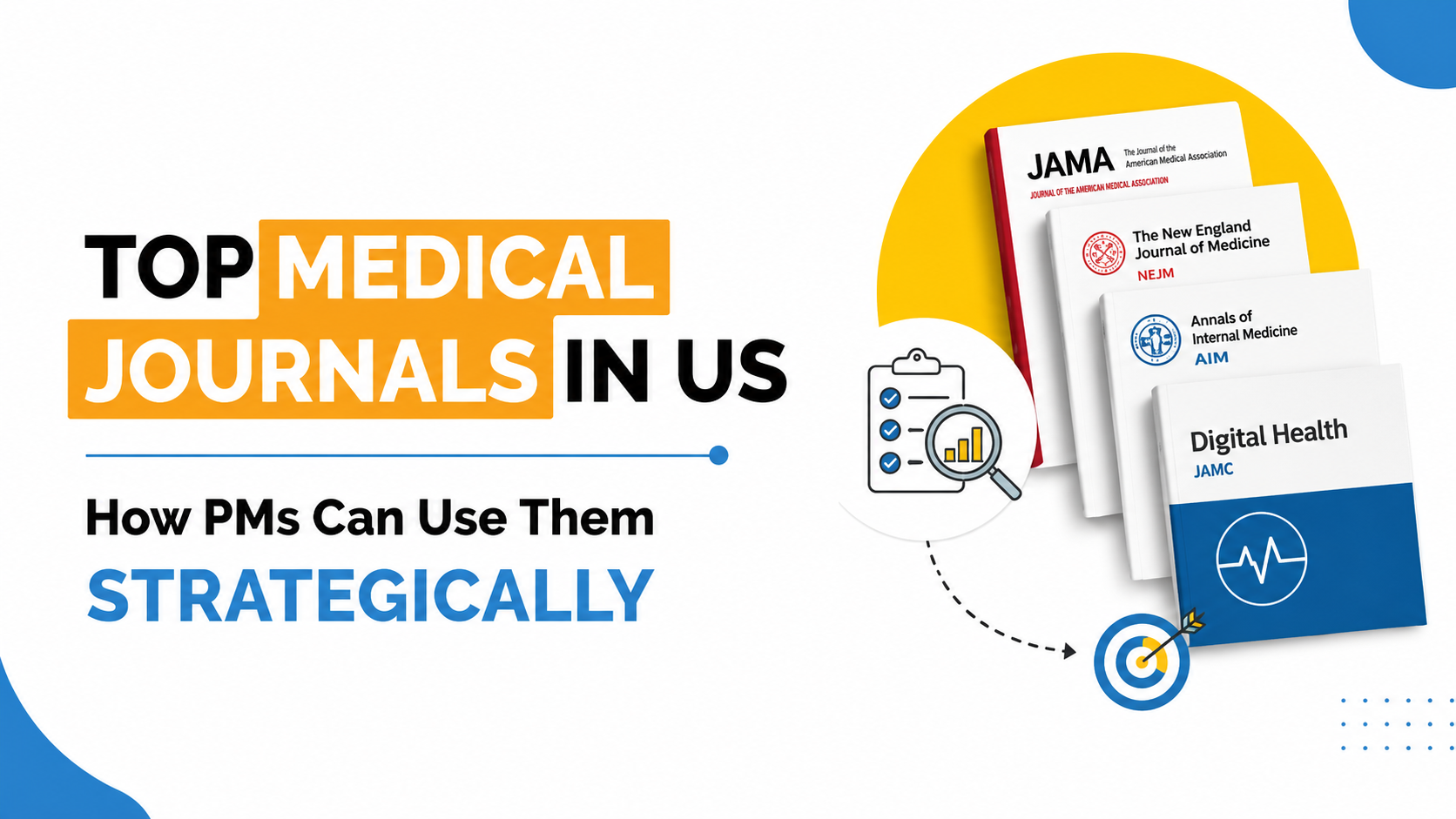
Introduction: Why US Medical Journals Matter for Product Managers
If you work in pharma, medtech, or healthtech, staying updated with the top medical journals in US is no longer optional, it is a core part of the job. Product managers who rely only on internal data and sales reports are working with half the picture.
The US is home to some of the world’s most rigorously peer-reviewed, globally respected medical publications. These journals publish clinical trial results, drug safety data, disease burden statistics, and treatment guideline updates, all of which directly affect the products you manage, the doctors you target, and the markets you plan to enter.
Role of Medical Journals in Healthcare Product Strategy
Medical journals do more than publish research. For product managers, they act as a real-time intelligence feed.
Here is how they directly shape product strategy:
- Clinical validation: Journals publish evidence that confirms or challenges a drug’s or device’s efficacy. This evidence becomes the backbone of your brand claims.
- Competitive intelligence: When a competitor’s drug gets published in a major journal, it signals pipeline maturity, target market shifts, and physician awareness.
- Guideline tracking: Updated treatment guidelines published in journals redefine prescribing patterns, and directly impact your product’s positioning on the prescribing ladder.
- Disease trend data: Epidemiological studies help PMs understand the size, growth, and geography of their target patient population.
- Regulatory alignment: The FDA and other regulatory bodies rely on peer-reviewed evidence. Keeping up with journals helps you anticipate what regulators will ask for next.
In short, medical journals connect your product decisions to the evolving science, which is exactly where great product strategy begins.
Why US Healthcare Product Managers Should Follow Trusted Research Sources
Not all research is equal. The internet is flooded with preprints, opinion pieces, and low-quality studies. For US healthcare product managers, the risk of building strategy on unreliable data is enormous, both for patient outcomes and for business credibility.
Trusted, peer-reviewed journals offer:
- Double-blind peer review ensuring data accuracy before publication
- High impact factors that reflect citation credibility within the scientific community
- Indexed access through PubMed, MEDLINE, and other trusted databases
- Transparency in methodology, which helps you evaluate whether findings apply to your product’s use case
When you present a clinical claim to a physician, a key opinion leader, or a regulatory reviewer, the strength of your evidence depends on where it was published. A study from NEJM carries far more weight than one from an unindexed journal. That is a commercial reality every product manager must understand.
If you want to understand how to turn this research into compelling brand narratives, explore eMediWrite’s Scientific Content Writing services, built specifically for healthcare brands.
Best Medical Journals in US Every Product Manager Should Know
Knowing which journals to follow is the first practical step. Not every journal is relevant to every product, but every product manager should at least know the top-tier names and what they cover.
US Medical Journals List for Pharma, Medtech, and Healthtech Teams
Beyond the top 10, different teams need different journals. Here is an extended US medical journals list organized by industry type:
For Pharma Product Managers:
- New England Journal of Medicine (NEJM)
- JAMA and JAMA Network Open
- Clinical Pharmacology & Therapeutics
- Drug Safety (Springer)
- Pharmacotherapy
For Medtech Product Managers:
- JAMA Surgery
- The Journal of Thoracic and Cardiovascular Surgery
- Journal of Medical Devices (ASME)
- IEEE Transactions on Biomedical Engineering
- npj Digital Medicine
For Healthtech and Digital Health Teams:
- npj Digital Medicine (Nature)
- Journal of Medical Internet Research (JMIR)
- Health Affairs
- JAMIA (Journal of the American Medical Informatics Association)
- Digital Health (SAGE)
Each of these publications provides insights specific to your domain, from post-market surveillance data in medtech to algorithm transparency debates in digital health. Building a reading habit around even two or three of these can significantly sharpen your market intelligence.
Leading Medical Journals US Teams Can Use for Market Research
Market research in healthcare goes beyond surveys and prescriber data. The leading medical journals US teams depend on can serve as primary research sources, if you know how to extract the right signals.
How Medical Journals in US Support Healthcare Innovation
Medical journals are often where innovation is announced before it reaches the market. Companies that monitor these publications gain a first-mover advantage.
Here is how medical journals in US actively support innovation cycles:
- Early signal detection: Phase II/III trial publications reveal upcoming competitive products 12–24 months before FDA approval.
- Unmet need identification: Systematic reviews and meta-analyses highlight gaps in current treatment options, which is precisely where new products should position themselves.
- Mechanism of action insights: Basic science journals like Cell and PNAS often precede commercial innovation by years, helping forward-looking PMs anticipate paradigm shifts.
- Real-world evidence (RWE): Post-market observational studies published in journals provide evidence beyond clinical trials, often influencing formulary decisions and payer conversations.
- Patient outcome data: Journals publish patient-reported outcomes (PROs) that can directly inform product design and marketing messages.
For example, when GLP-1 receptor agonists were shown in NEJM to have significant cardiovascular benefits beyond glucose control, entire commercial strategies were reshaped overnight. Product managers who were reading that research early had a significant strategic advantage.
Using Research Insights for Global Healthcare Market Research
The US may be your home market, but its journals carry global weight. Research published in American journals is followed closely by regulatory authorities, healthcare systems, and clinical communities worldwide.
How PMs can use US journal insights for global healthcare market research:
- Use US clinical trial data to build dossiers for market access in Europe, Japan, and emerging markets
- Reference NEJM or JAMA studies when presenting to global medical advisory boards
- Track disease incidence data from CDC-linked journals to compare the US vs. the global burden
- Use treatment guideline updates published in American journals as reference points for international KOL engagement
- Build evidence maps that show how US clinical evidence translates to different patient populations globally
The eMediWrite Brand Strategy & Positioning team specializes in translating complex clinical data into globally resonant brand messages, a critical skill for any PM operating across multiple geographies.
According to WHO’s global health data, disease burden metrics vary significantly across regions, and US journal data helps PMs build those cross-regional comparisons with scientific rigor.
| Download Our Medical Journals From HereClick Here |
How Product Managers Can Use Medical Journals Strategically
Reading journals is one thing. Using them strategically is another. This section is the practical heart of this guide, designed specifically for medical journals for product managers working in pharma, medtech, and adjacent spaces.
Medical Journals for Product Managers in Pharma and Medtech
Product managers in pharma and medtech face a unique challenge: they must translate clinical complexity into commercial strategy. Journals are the bridge.
Strategic uses of journals for pharma PMs:
- Claim substantiation: Every promotional claim needs a citation. PMs who regularly read journals are better equipped to identify publishable evidence that supports their brand’s key messages.
- Lifecycle management: As patent cliffs approach, journal data on newer mechanisms, dosing studies, or combination therapies can inspire lifecycle extension strategies.
- KOL identification: Authors of high-impact papers in your therapeutic area are often the most credible key opinion leaders. Journals help you find them before your competitors do.
Strategic uses for medtech PMs:
- Post-market surveillance: Journal publications often capture device performance data that regulatory affairs teams need for PMCFs (Post-Market Clinical Follow-ups).
- Predicate identification: For 510(k) clearance strategies, clinical journals help identify comparable cleared devices and relevant clinical benchmarks.
- Surgeon adoption signals: Technique papers and case series in surgical journals indicate where early adopter physicians are already using adjacent technologies.
For pharma product managers balancing these demands daily, this eMediWrite article on the challenges of pharma product managers offers a candid look at the pressures, and how scientific credibility helps navigate them.
Using Clinical Evidence for Product Managers
Clinical evidence for product managers is not just a compliance requirement, it is a competitive asset. Here is a practical framework for integrating evidence into your workflow:
The CITE Framework for PMs:
| Step | Action | Journal-Based Task |
| C – Collect | Build a journal watch list for your therapy area | Subscribe to NEJM, JAMA alerts; set PubMed email alerts |
| I – Interpret | Understand clinical endpoints and their commercial relevance | Learn to read forest plots, NNTs, and hazard ratios |
| T – Translate | Convert clinical findings into brand narratives | Work with medical writers to develop evidence summaries |
| E – Execute | Use evidence in MSL briefings, payer decks, and KOL meetings | Reference primary data, not secondary summaries |
This framework ensures clinical evidence moves from the journal page to the product decision table, systematically and compliantly.
Key types of clinical evidence to track:
- RCTs (Randomized Controlled Trials): Gold standard. Used for regulatory submissions and core brand claims.
- Meta-analyses: Aggregate evidence across multiple studies. Useful for showing consistency of benefit.
- Real-world studies (RWE/RWD): Show how your product performs outside trial conditions. Increasingly important for payer negotiations.
- Head-to-head trials: Directly compare your product vs. the competitor. High commercial value.
- Safety studies: Crucial for minimizing risk in promotional materials and physician conversations.
Turning Research into Product Roadmap Decisions
This is where journal reading delivers its highest ROI for a product manager. When you read a Phase III trial result, you should immediately ask:
- Does this change the standard of care in my indication?
- Does this open or close a market segment I am targeting?
- Does this validate or challenge the claims I am currently making?
- Does this create a new unmet need my next product could address?
- Does this strengthen or weaken a competitor’s position?
Every positive answer becomes a strategic input for your brand plan, your pipeline priorities, your clinical evidence strategy, or your medical education agenda.
For instance, a meta-analysis showing that a competing drug class has elevated cardiovascular risk could be the trigger for a head-to-head evidence campaign that repositions your product as the safer choice. That campaign starts with a journal paper, not a creative brief.
Want to understand how to build pharma strategies from the ground up? Read our guide on Pharma Branding Strategies to see how evidence-led brand building works in practice.
Benefits of Medical Journals for US Healthcare Product Managers
For US healthcare product managers, the benefits of consistent journal engagement go far beyond staying informed. They directly affect commercial outcomes.
Better Product Positioning and Documentation
Medical journals provide the scientific foundation for everything your product stands for.
- Differentiated positioning: When you can cite a landmark study that your competitors cannot, your product’s value proposition becomes defensible, not just aspirational.
- Regulatory-grade documentation: Journals are primary evidence sources. Building your product dossier on peer-reviewed publications significantly strengthens regulatory submissions.
- Labeling alignment: Understanding what has been published helps PMs stay aligned with approved labeling claims, avoiding off-label promotion risks.
- Value story development: For market access and payer negotiations, a structured evidence dossier sourced from top journals is often the deciding factor in formulary inclusion.
Stronger Stakeholder Communication
Whether you are presenting to the C-suite, briefing your MSL team, or preparing materials for a medical conference, journal-backed communication builds credibility.
- Physician engagement: Doctors respect peers who speak the language of evidence. When your MSLs cite NEJM or JAMA, it signals scientific seriousness.
- Internal alignment: Using journal data to support your brand plan recommendations gives leadership the confidence to approve budgets and prioritize your portfolio.
- Investor and board communication: For growth-stage healthtech and medtech companies, citing clinical evidence from credible journals supports the narrative of scientific validation.
- Payer and formulary presentations: Payers are sophisticated evaluators of clinical evidence. Strong journal citations in your AMCP dossier or value framework demonstrate robust evidence quality.
Evidence-Based Healthcare Marketing and Product Planning
The shift from feature-based marketing to evidence-based healthcare marketing is well underway, and it starts with journals.
How journals strengthen your marketing and planning:
- Message hierarchy: Build your brand’s core messages in order of evidence strength, strongest data first, supporting claims next.
- Campaign substantiation: Every claim in a promotional piece needs a citation. Journal access ensures you are never building on shaky ground.
- Medical education content: CME activities, symposia, and KOL slide decks should all trace back to peer-reviewed publications.
- Brand plan inputs: Market definitions, epidemiology estimates, and patient journey data sourced from journals make brand plans more credible and accurate.
For an inside look at how to build a comprehensive brand plan grounded in evidence, read These Questions Can Make or Break Your Pharma Brand Plan, a practical guide from the eMediWrite strategy team.
According to the NIH National Library of Medicine, PubMed currently indexes over 40 million citations. That is 40 million potential inputs for smarter product decisions, and most PMs are barely scratching the surface.
How eMediWrite Helps Healthcare Teams Use Medical Research Better
Reading journals is just the first step. Turning that research into usable, compliant, and compelling content for healthcare teams is a specialized skill, and that is exactly what eMediWrite does.
Medical Writing and Evidence Summary Support
eMediWrite’s team of qualified medical writers helps pharma, medtech, and healthtech companies translate complex research into clear, compelling, and compliant documents.
Services include:
- Evidence summaries and literature reviews – Structured summaries of key journal findings relevant to your product or indication
- Clinical evidence matrices – Organized tables mapping clinical data to brand claims
- Medical education materials – CME decks, symposia content, and KOL tools grounded in peer-reviewed evidence
- Scientific manuscripts – Support for publication planning, author assistance, and journal submission
Learn more about how eMediWrite approaches pharma manuscript writing from raw data to publication-ready documents.
eMediWrite is ISO 9001:2015 certified, which means every piece of content goes through a quality-assured process, not just scientific review, but also formatting, compliance, and communication excellence.
Research-Based Content for Healthcare Brands and Product Teams
Beyond medical writing, eMediWrite bridges the gap between clinical evidence and commercial communication. This is critical for product managers who need their research insights to translate into content that physicians, patients, and payers actually engage with.
What eMediWrite offers product teams:
- Brand strategy rooted in clinical evidence – Positioning work that starts from the science, not from marketing assumptions
- Digital and medical marketing content – From physician-facing digital campaigns to patient education materials, all built on published evidence
- Scientific storytelling – Through eMediCreate Studios, complex data is transformed into visual narratives that resonate in the digital age
- Regulatory-compliant content review – Ensuring that all claims are substantiated, appropriately referenced, and aligned with current guidelines
Explore eMediWrite’s full range of services to see how evidence-based content strategy can accelerate your brand’s commercial performance.
Whether you are a pharma PM trying to defend a formulary position, a medtech PM preparing for a product launch, or a healthtech team looking to establish clinical credibility, eMediWrite provides the medical writing infrastructure to make research actionable.
Conclusion
The top medical journals in US are not just academic resources, they are strategic tools for every product manager operating in the healthcare space. From identifying unmet needs and tracking competitor pipelines to building compliant brand claims and engaging key opinion leaders, the value of consistent journal engagement is hard to overstate.
The best PMs in pharma, medtech, and healthtech treat clinical evidence not as a compliance burden, but as a competitive advantage. They read the journals, extract the signals, and translate them into decisions that move their products and their organizations forward.
If you need support turning that clinical evidence into compelling, compliant, and commercially effective content, eMediWrite is built exactly for that purpose. Explore the blog, connect with the team, and start building a research-powered product strategy today.
Frequently Asked Questions
What are the best medical journals in US?
The best medical journals in US include the New England Journal of Medicine (NEJM), JAMA, The Lancet (US Edition), Annals of Internal Medicine, Circulation, and Journal of Clinical Oncology. The right journal for your needs depends on your therapeutic area, cardiology, oncology, diabetes, and general medicine each have their own leading publications.
Where can I find a US medical journals list?
A comprehensive US medical journals list is available through resources like PubMed/MEDLINE, the NLM Catalog, and the Journal Citation Reports (JCR) by Clarivate. These databases index thousands of peer-reviewed US journals and allow filtering by specialty, impact factor, and indexing status.
How can product managers use medical journals strategically?
Product managers can use medical journals strategically by monitoring for competitor trial results, building evidence-based brand claims, identifying key opinion leaders through authorship, tracking disease epidemiology data, and using clinical insights to inform product roadmap decisions and market access strategies. The CITE framework, Collect, Interpret, Translate, Execute, provides a practical process for integrating journal research into daily product strategy work.
Why is clinical evidence important for product managers?
Clinical evidence is important for product managers because it forms the scientific foundation for brand positioning, regulatory submissions, payer negotiations, and physician communication. In a heavily regulated industry, unsupported claims carry serious compliance risk. Strong clinical evidence, sourced from peer-reviewed journals, not only protects against regulatory challenges but also builds credibility with healthcare professionals and accelerates commercial success.