
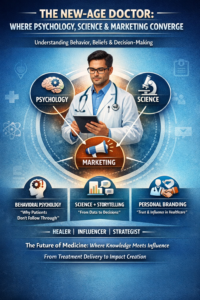
The most effective doctors are those who understand behaviour, belief systems, and decision-making. Patients don’t act on science. They act on perception. And perception is driven by psychology.
The missing link in clinical practice: Behavioural psychology
Every doctor has faced this frustration:
- The prescription is correct
- The diagnosis is accurate
- The outcome should be good
Yet the patient doesn’t follow through. Why? Because compliance is not a medical issue—it’s a psychological one.
Key behavioural drivers in patients:
- Loss aversion → Patients fear side effects more than disease progression
- Instant gratification bias → Preference for quick relief over long-term therapy
- Authority bias → Trust increases when the doctor demonstrates certainty
- Social proof → “Other patients like you improved” increases adherence
A doctor who understands these doesn’t just prescribe. They influence decisions.
Science builds credibility, but psychology drives action
Clinical data is powerful—but only if it is communicated effectively.
Let’s take an example:
- Scenario A (Pure Science) = “Studies show this drug reduces HbA1c by 1.5%.”
- Scenario B (Science + Psychology) = “This treatment has helped patients like you reduce complications by nearly 40%—and most start seeing improvement within weeks.”
Both are scientifically valid. But one Scenario B (Science + Psychology) moves the patient to act.
The Framework: SCIENCE → SIMPLIFICATION → STORY
- Science → Evidence, trials, guidelines
- Simplification → Make it understandable
- Story → Make it relatable
That’s where influence happens.
The doctor as a brand: Trust is the new currency
In today’s digital and competitive healthcare ecosystem:
Patients don’t just choose treatment. They choose doctors.
And doctors are evaluated based on:
- Perceived expertise
- Communication clarity
- Emotional connection
- Visibility
This is where ethical medical marketing comes in.
What marketing really means for Doctors
Marketing is not manipulation. It is structured communication of value. A doctor who markets ethically:
- Educates consistently
- Positions themselves as an authority
- Builds trust at scale
Clinical practice meets sales strategy
Many doctors resist the idea of “sales.” But let’s redefine it: Sales = Helping a patient confidently say YES to the right treatment. That’s it.
The 4-step clinical conversion model
1. Build Trust (First 2 Minutes)
- Confident body language
- Clear introduction
- Active listening
2. Diagnose with Authority
- Explain findings in simple terms
- Use structured thinking
3. Frame the Solution
- Highlight consequences of inaction
- Emphasize benefits clearly
4. Close with confidence
“We’ll start this today.” Not “What do you want to do?” Because uncertainty from the doctor creates hesitation in the patient.
The power of positioning in healthcare
Two doctors with the same qualification can have vastly different outcomes. Why? Positioning.
- Doctor A: = “I treat diabetes.”
- Doctor B: = “I help patients reverse early diabetes and avoid lifelong complications.”
Who do patients trust more? The second doctor isn’t just treating a disease. They are selling an outcome.
The future: Integrated doctor = healer + influencer + strategist
The next generation of successful doctors will not be defined by degrees alone. They will be defined by their ability to:
- Understand human behavior
- Communicate science effectively
- Build a personal brand
- Influence decisions ethically
Final thought
The best doctor is not the one who knows the most. It is the one who can make the patient act on what they know.
When psychology, science, and marketing come together, medicine transforms from treatment delivery → impact creation.
About the Author: Dr. Kamal Asnani is a medical professional, entrepreneur, and founder of a leading medical communications ecosystem. He specializes in bridging the gap between clinical science, behavioural psychology, and strategic healthcare communication, helping doctors, brands, and organizations create real-world impact.